


7 Powerful Ways Intergenerational Care Transforms Alzheimer's Support
Bringing Generations Together: 7 Powerful Ways Intergenerational Care Transforms Alzheimer’s Support
Story
Today I feel the pull of the anchor.
When you see the word anchor, read: my loved one with Alzheimer’s.
This anchor has been growing barnacles, becoming heavier and more deeply entrenched in the floor of the sea. Some days, I wonder if it will ever break loose.
When my attention drifts toward the playful laughter of my children and family, I feel myself straining against the anchor rope, trying to engage, trying to be fully present, only to be pulled sharply back into my role as caregiver.
How I long to break free and fly.
The children circle close to me because I can't always go to them. I want to protect them from becoming tangled in the anchor rope that now binds my life, yet I also want the children to understand why I choose to stay bound to my anchor.
This anchor once held me safely through storms from the very beginning of my life. Staying attached to the anchor now feels like the least I can do.
But the anchor and the rope pull on my marriage, my children, my dreams, my energy, and sometimes even my sense of self.
How do I honor the anchor while also honoring myself and my children?
A boat was never meant to remain tied to the shore forever. It was made to drift, explore, dance with the wind, and return again.
And now, for the first time in a long while, I see a possiblilty that I can let go of the anchor for a short while.
I have discovered adult day centers - a place where I can take my anchor for a bit, and know that my loved one is safe and will have positive experiences while I have a break to do some much needed self-care.
Google 'Adult Day Centers' in your area to find those nearest you from which to choose.
Perhaps the answer is not choosing between the anchor and the children.
Perhaps the answer is learning how to let them be together in safer waters.
Because even in the middle of Alzheimer’s, meaningful connection between generations is still possible.
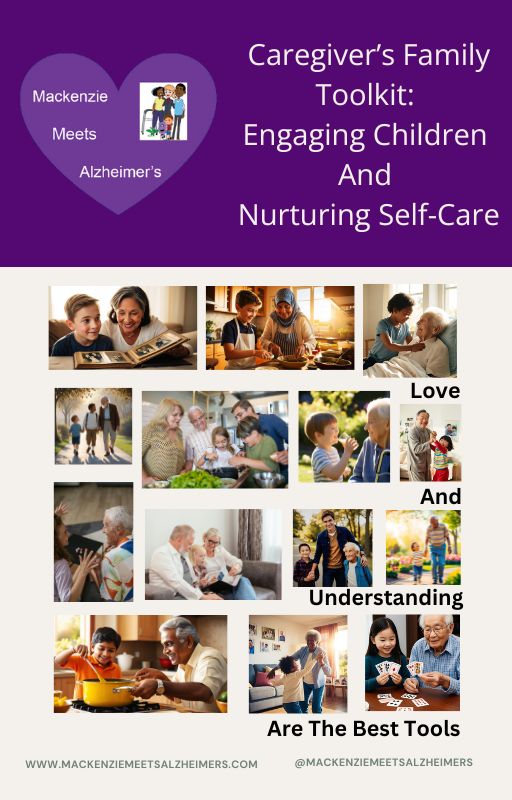
Children and older adults don't need perfect moments to create meaningful memories together. Often, the smallest interactions — a song, a laugh, a shared picture, a quiet hand to hold — become the moments families remember most.
The key is learning how to nurture those connections in ways that are sustainable for everyone involved.
Here are practical, easy-to-implement strategies families can use:
1. Keep Activities Simple and Flexible
Children and older adults connect best through low-pressure interactions:
Coloring
Listening to music
Looking at photo albums
2. Focus on Emotional Connection Over Memory
Don’t worry if names or details aren’t remembered. What matters is how the moment feels.
3. Encourage Natural Interaction
Avoid scripting or over-explaining. Let children lead with curiosity and playfulness.
4. Use Music as a Bridge
Music activates memory and emotion. Singing familiar songs together can spark engagement.
5. Create Routine Visits
Consistency builds comfort for both children and individuals with Alzheimer’s.
6. Teach Children What to Expect
Prepare kids with simple, age-appropriate explanations:
“Grandma may forget things, but she still loves being with you.”
Grandma might tell you a story that doesn't make sense. Ask her questions about the story. Laugh with her if she laughs. Comfort her by holding her hand or telling her you understand if it's a sad story.
7. Balance Connection With Support
Combine family interaction with structured care (like adult day programs) for sustainability.

The Science Behind Intergenerational Care
Intergenerational engagement works because it taps into preserved emotional memory pathways. Even as cognitive abilities decline, emotional responsiveness often remains. According to the Alzheimer’s Association:
Social interaction can reduce behavioral symptoms
Positive engagement improves overall well-being
Routine and stimulation support cognitive function
Children naturally provide:
Unfiltered joy
Sensory stimulation
Emotional authenticity
These elements are difficult to replicate in structured care alone.
When to Seek Additional Support
It may be time to consider outside help if:
You feel consistently overwhelmed
Care responsibilities impact your health
Your loved one needs more engagement than you can provide
Family balance is suffering
Seeking help is not giving up—it’s strengthening your ability to care.
Frequently Asked Questions (FAQs)
1. Can children really help someone with Alzheimer’s?
Yes. Children provide emotional engagement and stimulation that can improve mood and responsiveness.
2. Is intergenerational interaction safe?
Yes, with supervision. Activities should be simple, calm, and appropriate for both ages.
3. What age is best for children to participate?
All ages can participate, but younger children often bring the most natural, pressure-free interaction.
4. How often should visits happen?
Consistency matters more than frequency. Even short, regular visits can be beneficial.
5. What if my loved one doesn’t respond right away?
That’s normal. Engagement may vary day to day. Focus on creating a positive environment.
6. Are adult day centers necessary?
Not always, but they are highly beneficial when caregiving demands exceed what families can manage alone.
Small Moments, Lasting Impact
Feeling the pull of the anchor does not mean we are constrained. It reminds us that connection doesn’t disappear with memory. It simply changes form.
Bringing generations together:
Restores dignity
Encourages joy
Strengthens family bonds
But sustainable caregiving requires balance.
By combining:
Intergenerational moments
Structured support
Community resources
Families can create not just care—but meaningful, JOYful experiences.
Ready to Create More Meaningful Moments—Without Burning Out?
Caring for a loved one with Alzheimer’s while raising a family can feel overwhelming—but you don’t have to figure it out alone.
Supporting Research & Evidence-Based Content
Alzheimer’s Association – Caregiving Resources
https://www.alz.org/help-support/caregiving
Supports claims about emotional engagement, caregiving strategies, and quality of lifeAlzheimer’s Association – Adult Day Centers
https://www.alz.org/help-support/caregiving/care-options/adult-day-centers
Validates benefits of structured care and social interactionNational Institute on Aging – Getting Help with Alzheimer’s Caregiving
https://www.nia.nih.gov/health/alzheimers-caregiving/getting-help-alzheimers-caregiving
Government-backed authority on caregiver support and burnoutNational Institute on Aging – Activities for People with Alzheimer’s Disease
https://www.nia.nih.gov/health/alzheimers-caregiving/activities-people-alzheimers-disease
Supports intergenerational engagement and activity recommendations
CDC – Healthy Aging & Social Connectedness
https://www.cdc.gov/aging/publications/features/lonely-older-adults.html
Supports claims about isolation, depression, and social benefitsJournal of Intergenerational Relationships (Overview)
https://www.tandfonline.com/toc/wjir20/current
Academic support for intergenerational engagement outcomesAARP – Caregiving & Family Support
https://www.aarp.org/caregiving/
Reinforces multigenerational caregiving realities