


Guidance For Caregivers And A Child-Friendly Resource For Children
What Children Need To Know About Alzheimer's And Unpredictable Behaviors
This blog discusses how to explain Alzheimer’s disease to children and the challenging behaviors that may occur. Watch this short video for information, tips, and activities.
Children who have reading skills would benefit from having Alzheimer's education at their fingertips. Download our PDF, Alzheimer's Disease: A Child-Friendly FAQ Resource, below and print it out so your child has this information and you both can learn the best times to interact, when to end the interaction, and types of activities recommended.

Information:
While difficult, this information is included to help caregivers protect both their loved ones and their children. Alder was reading posts in an Alzheimer’s support group on Facebook. One of the issues of concern was inappropriate sexual behavior. A sandwich-generation caregiver reported that her young child wanted to sleep in her grandfather’s bed. Her grandfather has dementia. Many people on Facebook responded with concern—and here’s why.
Alzheimer’s disease affects the brain in ways that can lead to unpredictable behavior. The areas of the brain that manage impulse control and judgment may be damaged, meaning a person with Alzheimer’s might say or do things they wouldn’t have when healthy.
Even if you try to correct or remind your loved one with Alzheimer's or any type of dementia to behave appropriately, it often doesn’t help. Unlike a child, someone with Alzheimer’s typically can’t learn—or relearn—appropriate behavior. This can be very frustrating for caregivers, but it’s important to remember it’s part of the disease, not something the person is doing on purpose.
Because of this, all interactions between children and a loved one with Alzheimer’s should be supervised by a responsible adult and it's probably not a good idea to allow a child to sleep in the same bed as someone with dementia. However, if this was a common practice before diagnosis, use discretion on allowing it post diagnosis.
Helping Children Understand and Stay Safe
While a person with Alzheimer’s may struggle with behavior, children can learn what is safe and appropriate. If a child sees or experiences something that feels wrong or confusing, they should know to find a trusted adult right away.
Teaching children how to recognize unsafe behavior—and seek help—gives them lifelong tools to protect themselves. Be honest in an age-appropriate way. Let them know that their loved one’s actions are caused by the disease, not because they are a bad person. This may be confusing at first, but over time, children can develop both understanding and empathy.
These behaviors can manifest as terrifying or delightful.
Some of the terrifying behaviors include:
Quick to anger and frustration
Sundowning - an increase of inappropriate behavior in the evening as the sun goes down
Overt sexual behavior
Some of the delightful behaviors include:
Playfulness
Funny stories
Appropriate affectionate behavior
Below are some tips on ways to mitigate the terrifying behaviors and encourage the delightful ones.
Don’ts
Don't have a lot of noise and confusion in the home, like the TV blaring, people talking loudly over it, music blaring, etc.
Don't overwhelm your loved one with conversation or questions.
Don't expect your loved one to be able to do the things they used to do.
Don't keep the house or room dark and gloomy.
Don't try to teach your loved one something new.
Don't expect your loved one to remember how to do something.
Don't correct your loved one if they tell a story different from how you remember it.
Dos:
Maintain a calm, quiet, loving atmosphere - leave the outside voices and outside activity outside.
Ask one question or present one idea at a time and give your loved one time to process it and respond.
Just smile and move on if their response to a question or statement doesn’t make sense.
Play very familiar games or do familiar activities.
Dance or sing to your loved one's favorite songs from their childhood.
Gently remember for them when they can’t remember something.
Keep their inside space well-lit.
Listen to verbal communication and observe non-verbal communication to determine what your loved one needs.
Activities:
Familiar activities are the best; your loved one can’t learn a new game.
Play can involve toys; many women with Alzheimer’s or dementia like to play with dolls, and men like to do things that remind them of fixing things, like messing with different kinds of latches.
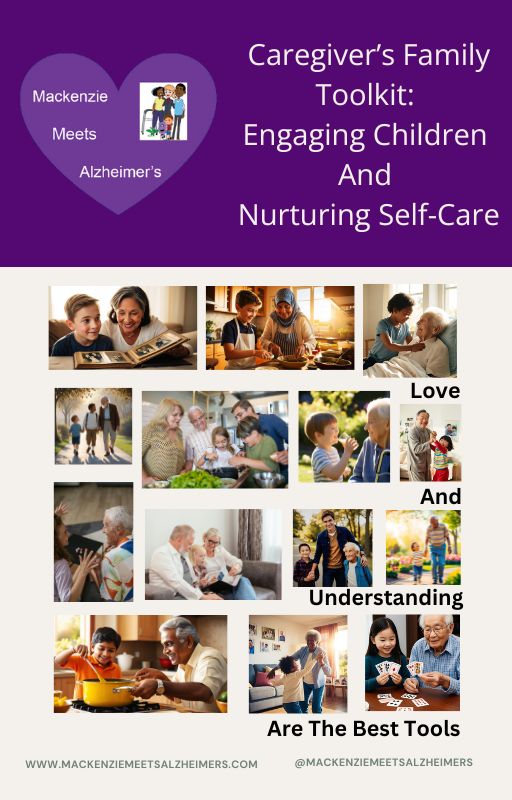
Make a memory book.
Encourage storytelling
Make easy snacks together.
Actions:
Download the PDF, Alzheimer’s Disease: A Child-Friendly FAQ Resource, and discuss with your child or children what happens in the brain of someone who has Alzheimer's disease.
Describe scenarios in which the children should come to you for help.
Provide fun activities for the child and your loved one to do together.
Teach your children to assist you in keeping the areas of interaction clean, uncluttered, and full of light.
Don’t take terrifying behaviors your loved one presents personally. Understand it’s the disease causing these behaviors, and consult with a health care professional for assistance in managing these behaviors.
In Conclusion:
A person with Alzheimer’s can have unpredictable behavior. The part of the brain that controls behavior can be damaged by Alzheimer’s. This prevents the person from being able to learn or relearn controls on their behavior, and can cause them to act impulsively.
However, a child can learn the difference between acceptable and unacceptable behaviors. When a child observes or experiences an inappropriate or disturbing behavior, teach the child to seek out a responsible adult.
It’s important to teach children how to keep themselves safe. These lessons will serve them throughout their lives. Explaining to a child that the disease is responsible for the behavior, not their loved one, can cause a bit of confusion at first.
Children are hard-wired to pay attention to their environment. It is a survival mechanism. They know something is different in their loved ones. Understanding Alzheimer’s takes them out of the dark into the light.